2014年2月23日日曜日

YES! YES!
I am done with my research paper and presentation!


However, I hardly believe our RW class almost ended ;( I was super impressed by various things I learned and it was more than expected! (I highly recommended Ken's class when my friends in st-3 are choosing their RW class! haha)

First of all, Leading at the Edge was great book. I was convinced why Shackleton had great leadership. Plus it was very persuasive since Shackleton's journey was actual event. The book is quite heavy to carry everyday, but it is worth it!

The lectures Ken arranged for us were also worthwhile and valuable opportunity for me. If I was not in this RW class, probably I will never meet two wonderful leaders. I realized that not only reading and understanding some leaders' great skills, but also actual meeting and talking with great leaders has huge meaning. 

Of course, I am really impressed Ken's lectures! I will not forget "brief, warm, firm" handshake! And thank you a lot for giving us mikans (oranges) and snake eggs! haha


What we learned was really practical and definitely can be utilized in our daily lives. I was so happy to be one of the member of leadership class!

Thank you, Ken and you guys! (I know we still have a class tomorrow... hehe)


2014年2月14日金曜日

The Lecture of Ms. Hibiya

Thank you, Ken for holding the wonderful and precious lecture. the lecture by actual leader inspired me a lot as well as one by Mr. Kitashiro. First of all, before Ms. Hibiya entered the classroom. some classmates and I were talking about the schedule of next term. Then, she entered and naturally participated in our conversation and answered some questions we had. I was little surprised, but at the same time, I was so happy to communicate frankly with her.

What she has told us in her lecture is basically divided into 5 tips.

1. Study 3rd Language

Ms. Hibiya told that learning new language provides new perspectives and the more languages you learn, the more opportunities for you.

2. Find Your Passion!

She mentioned about the ICU's liberal arts system and told us that the major does not really mean when you look for job. Therefore find something interesting and do it.

3. Seek Funding

She strongly addressed that we should not complain about money. Today, there are many funding around us. We won't get anything unless we seek it.

4. Study Abroad

Again, she said it broaden your perspectives through the experience in abroad.

5. Do Exercise

She suggested us to do something regularly. It keeps our bodies healthy, not only our physical state, but also mental state.

I think I miss some tips, and overlapped some with other classmates. So it is probably better to look mine as supplements.
Anyway, she was so nice person and it was truly great opportunity to talk to her because if I was not in leadership class, probably I would not have chance to talk to her in school. Again, thank you, Ken, it was soooooooo wonderful lecture for me! 

2014年2月8日土曜日

The Lecture of Mr. Kitashiro


First of all, I greatly appreciate Mr. Kitashiro's visit and his lecture only for us. I could not believe the former president of IBM was standing front of me and he delivered his leadership skills mixed with actual experiences. I really remembered that how important to be positive and smile. He actually always smiled and never looked like pessimist during the lecture. However, it seems quite difficult being positive all the time, everyone has experienced being negative at least once, it's impossible to never think negatively. Therefore, I thought what Mr. Kitashiro has been doing is even though he feel negatively, he keeps it inside and never express in order to keep the productivity and morale of his employees high.


I also recognized that some skills he showed us were resemble to what we learned from Shackleton. Then, I realized that great leaders are people who could actually practiced those skills. Anyone, including us, is able to learn skills from books, lectures and so on, but it is meaningless if we only learn, only acquire the knowledge. We have to become brave to practice them.


As he told us "Do your best at the current position", I will try to do my best, and try to be positive as much as possible:) Soooooo, I will continue writing my essay... It is what I can do now. haha


The Power of Negative Thinking


Many great leaders, including Shackleton and  Mr. Kitashiro keep insisting the importance of being positive. Obviously it is true that positive thinking provides various benefits. However, surprisingly, some people support the idea of being negative. It totally depends on what kind of job you work for or what kind of action you take, but it might be necessary to be discreet in some situations. 


This idea seems exactly opposite of what we learned, but I found this interesting and somehow persuaded. For example, if you arrange to meet somebody, probably you do not want to be late, especially when you are the host of some kind of meeting or meeting with your boss. What you do is probably going the place earlier and wait until they come. You might be there 30 mins earlier even though 15 mins is enough because you think what if the train would be delayed, what if your boss do not know the meeting place and get lost. This negative thinking is actually meaningful. You are able to avoid risks and cope with them because you already expect the worsest situation beforehand. However, of course, it is meaningless if you only beware of the worsest and do not take any action. Consequently, the balance between the positive and negative thinking is essential.
I personally think that when I go abroad, this negative thinking is worth. We live in this safe and peaceful country, Japan and do not really aware of own security (compare with other countries, I guess?). However, there are many countries you have to save your life by yourself, then it is really important to expect the worsest situation and try to avoid it, which lead to save your life.


2014年1月31日金曜日

Leadership Skills and Psychology


Negotiation & Peace?????


In this winter term, I take Peace Research class, and I found the interesting reading which relate to what we learned, the negotiation and conflict resolution. The reading is called Contribution of Positive Psychology to Peace and it analyzes the relationship between positive psychology and peace psychology. It seemed there is no relevance to our leadership class, but the author mentioned the psychological views which can be applied to our leadership studies.

The author says that positive affect reduces contentious tactics and competition, then, increase the concessions and cooperation in the conflict resolution. Moreover, it revealed by the research that happy negotiators are more likely to use more cooperative strategies during the negotiations than sad negotiators. The reason is happy negotiators plan to be cooperative before actual negotiations to achieve better agreements.

In sum, positive affect have desirable influence on the negotiations and problem solving, and if you have positive emotion, you will be able to usefully contribute in conflict resolution.

It was quite surprising for me that I did not expect the relation with Peace Research and this class. However, I could understand that resolving conflicts is somewhat the peace because it results in the resolution which means no more conflict. (This type of peace is called "Negative Peace" in terms of peace study.)

Chapter 5&6

5                                   6

The Team Message   Core Team Value


http://www.actioncoach.com/siteFiles/photos/articles/Great_Communication_Great_Team_1.jpgChapter 5 and 6 are both about "team" which is easily applied to our daily lives. When I was in volleyball team at middle school(sorry, I always cite this example...), teamwork was the most essential skill, probably even more than skills of playing volleyball itself. The reason is if players individually play in the court, the ball immediately fall. Every single player had to communicate with others and confirm each roles. Otherwise, the team would never win the game. As the author of this book says "frequent communication is always important in maintain a sense of team unity", communication was necessary both inside and outside of the court.
 

In addition, it is not too much to say that the victory or defeat totally depends on what kind of environment the team creates. If the team creates a good atmosphere, the team will likely to win, and vice versa. Therefore, every time we have the game, we  had a meeting, and shared information and tried to create a better atmosphere. In order words, strengthen the team unity through meetings in order to accomplish the same goal, which is the victory.


http://www.real-estate-team-coaching.com/blog/wp-content/uploads/2011/11/BuildingTeam-300x225.jpgLastly, my coach always told us to say "Thank you", "You did well!", "Otsukaresama". Those were commonly used phrases, but they had huge meaning which strengthened the team and "lubricated social interaction". I realized that my coach was not really a leader, but expert in uniting the team.

2014年1月26日日曜日

Yutaka Oda

 Have you ever seen this person?


I guess the most of people say "NO", but you definitely know the name of the company he works for...


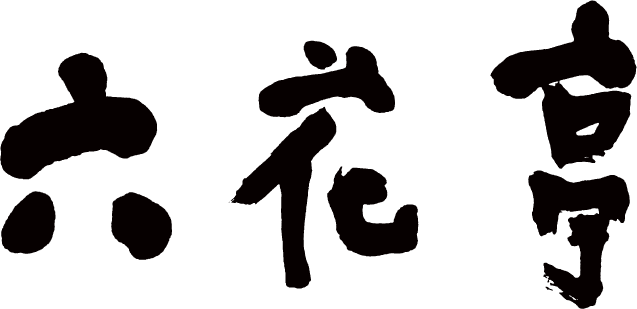
The company placed in Hokkaido, and this Butter Sand is really popular for a souvenir of Hokkaido. You may have had a chance to eaten before.  Yutaka Oda(小田豊) is the president of Rokkatei and known for his unique techniques of leadership.

First of all, I introduce Rokkatei briefly. Rokkatei does the production and marketing only in Hokkaido and does not place any branch in Tokyo. However, The sale of its company is top among the manufacturing industries in Japan which does not have any branch in Tokyo. Even though it is an isolated company, Rokkatei is 13th in the ranking of companies in Hokkaido which the new graduates want to work.  

Why is Rokkatei so popular?

The reason seems to be unique ways to motivate employees. These are some of them.

  • Giving 15万円 every month to the employee who tried the hardest (+ Sushi).
  • Command employee for anything even outside of the company, such as regional volunteers
  • Giving 20万円 for each employees per year as travel expenses when travel with 6 or more employees

    In addition, he willingly interview applicants and even part-time workers, and decide whether he/she is acceptable. He really love employees and always puts employees first. Sometimes it is necessary to focus on business, but taking care of its employees is important as well. I could easily understand why Rokkatei is so loved by people.